

Notice: Undefined variable: paywall_console_msg in /usr/web/cs-washington.ogdennews.com/wp-content/themes/News_Core_2023_WashCluster/includes/single/single_post_meta_query.php on line 71
Notice: Undefined offset: 0 in /usr/web/cs-washington.ogdennews.com/wp-content/themes/News_Core_2023_WashCluster/single.php on line 18
Notice: Trying to get property 'cat_ID' of non-object in /usr/web/cs-washington.ogdennews.com/wp-content/themes/News_Core_2023_WashCluster/single.php on line 18
Mental health issues pose challenges for police
Notice: Undefined offset: 0 in /usr/web/cs-washington.ogdennews.com/wp-content/themes/News_Core_2023_WashCluster/includes/single/strategically_placed_photos_article.php on line 412
Notice: Trying to get property 'term_id' of non-object in /usr/web/cs-washington.ogdennews.com/wp-content/themes/News_Core_2023_WashCluster/includes/single/strategically_placed_photos_article.php on line 412
The call came in from the 911 center as a welfare check on a woman known to Waynesburg police.
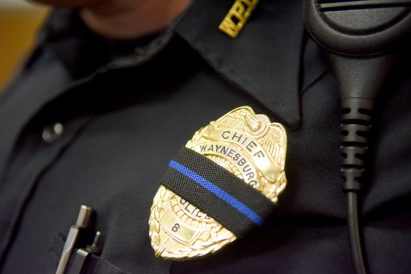
Though the call appeared to be routine, Chief Rob Toth had no idea what he was about to encounter on that day five years ago.
“I found her upstairs, lying on the floor with a plastic bag over her head and a bottle of Drano next to her, and a family picture next to her, and the phone was off the hook,” he recalled.
Toth ripped open the bag and attempted to get her away from the caustic substance.
“I pulled her arm, and she came up with a knife and almost stabbed me,” he said. “Technically, that would be aggravated assault of an officer, but she wasn’t in the right state of mind. She needed to go to the hospital to be evaluated. She needed help.”
An estimated 43.8 million American adults – about 1 in 5 – have a diagnosable mental illness, according to the National Alliance on Mental Illness. Often, police are called upon to assist when a mental health crisis occurs.
And sometimes, those calls turn violent.
In an incident that still has the community reeling, Canonsburg Police Officer Scott Bashioum was killed Nov. 10 while answering a domestic violence call. Michael Cwiklinski had previously undergone a mental health evaluation that indicated he had anger management issues but did not reveal additional psychiatric problems. He killed Sabae and Bashioum before taking his own life.
“I don’t know anyone in this field who hasn’t addressed it (mental health issue), in one form or another,” says Southwest Regional Police Chief John Hartman, who is also a Beaver County Police Academy instructor.
While there’s no standard response set forth to handle such situations, Hartman believes strides have been made in understanding and more effectively dealing with those who are struggling with mental health problems.
“We’re more in tune with what we see and why are we seeing it,” said Hartman.
Twenty years ago, officers responding to a call might not have considered mental health a factor. Now, they know they may be dealing with a head injury, a chemical imbalance or any number of issues. They also know their response can greatly impact how the rest of the call plays out.
“We want a more humane, humanistic understanding of what the problem is and how to respond, at the same time, making sure that every effort is made to protect officers, people and themselves,” said Hartman.
In his capacity as an instructor, Hartman is qualified to teach courses in mental health to officers, sheriffs and constables in training.
“The more understanding we have of the problem, the better understanding we have of how to respond to that problem,” he said. “(We have become) more in tune with what the victim is feeling at the time. I think that’s where law enforcement has made leaps and bounds.”
At police academies and in state police basic training, recruits are taught how to identify a potential problem and an appropriate set of responses. If a person has been identified as having a mental health issue, officers can tailor their language or change their tone in an attempt to defuse a situation.
According to Ryan Tarkowksi, a state police spokesman, students are presented with various scenarios designed to test judgement and decision-making during encounters with those who have special needs, including mental health issues.
Michael Crabtree, a Washington & Jefferson psychology professor and a licensed psychologist in private practice, administers mental health evaluations for police employment screenings and debriefs officers after stressful or traumatic incidents such as shootings.
In a volatile situation, typical command instructions could be replaced with more soothing and supportive language to de-escalate a situation.
“Verbal dominance … is going to scare some of these categories of people and create some emotional reactions,” he said.
John Hritz, a Washington police officer and president of the local Fraternal Order of Police, said if a person is really agitated, officers may change their approach.
“If you try to put yourself in their place, reality for them is probably a lot different than what it is for the police officers,” he said.
While mental health training is a part of ongoing officer education, there is no substitute for experience.
“On calls, you try to step up and take the lead,” Hritz said. “You practice your active listening and try to de-escalate the situation.”
Waynesburg police Officer Shawn Wood said when responding to a mental health call, it’s important for officers to be able to relate to those with whom they are interacting.
“You have to be able to talk to people,” he said. “You have to find common ground with them and let them know that you’re human just like they are.”
Toth, who has been in law enforcement for 24 years, said in his small community of Waynesburg, most offenders are repeat offenders. However, every call is unpredictable.
He believes that when people with mental health conditions become violent or combative, the best approach an officer can take is to get the person under control and take them to the hospital.
Ankrom said safety comes first – something that Hartman has been teaching as a first line of response for years.
“As law enforcement, our issue is to stabilize a situation and get it into more competent hands to handle it on a long-term basis,” Hartman said. “It’s critical that if we’re the first ones on the line, that we don’t make it worse and whatever we do improves the situation and well-being of the person.”
Crabtree believes officers and other first responders benefit from mental health education. Distinguishing a person who is overwrought from someone who has a mental health problem is very difficult.
“Mental health issues do not present themselves in a singular form,” Crabtree said. “It’s a split-second decision of what to do.”
Just as there is a spectrum of encounters, there are multiple responses officers can choose based on that situation.
“It is a response that requires skill and training and understanding – understanding the condition a person is in and what our limitations are,” said Hartman.
Some factors officers may consider include the history of encounters with the person, what resources they have and how quickly can those resources be accessed. Hospitals, mental health facilities and trained professionals are often employed.
Toth said officers in his department often take mental health patients to the hospital or follow the ambulance to make sure everyone stays safe.
“We always stress that we’re here to help people,” he said. “You just use the force necessary and control the situation. It’s for our safety, the public’s safety and the safety of the person we’re dealing with.”
Police officers have some discretion when it comes to filing criminal charges against a person with a mental health disorder.
Typically, said Waynesburg police Officer Tom Ankrom, if other victims are involved, or if an officer is injured, charges will be filed.
Tarkowksi said sometimes police must decide whether a person has the ability to understand that their actions are criminal. Criminal penalties can be waived in some instances, with successful completion of mental health evaluation and/or services.
Officers also consult with the district attorney’s office to determine if charges are warranted.
Hartman said an officer’s role is not to dole out punishment.
“That’s the court system. (Officers) are trained to respond,” he said. “We’re the first step in the process. We are not the end of the process.”
Hartman believes officers act with the best intentions.
“When I ask someone why they want to be a police officer, I inevitably hear, ‘I want to help.’ We want to help people as best as we can,” said Hartman. “These situations can be so explosive, we have to make sure we’re improving the situation. There’s been a huge effort to really give an appropriate response. Are we continually working to make our responses more effective? Yes, and I think it’s going to continue.”
Crabtree believes more in-depth training on specific mental health disorders and what they can look like would benefit first responders.
“Police officers need to be able to distinguish between these categories. How is someone who is schizophrenic different from someone who is autistic or someone who has overdosed?” he said. “That’s the difficult thing to do.”