

Notice: Undefined variable: paywall_console_msg in /usr/web/cs-washington.ogdennews.com/wp-content/themes/News_Core_2023_WashCluster/includes/single/single_post_meta_query.php on line 71
Notice: Undefined offset: 0 in /usr/web/cs-washington.ogdennews.com/wp-content/themes/News_Core_2023_WashCluster/single.php on line 18
Notice: Trying to get property 'cat_ID' of non-object in /usr/web/cs-washington.ogdennews.com/wp-content/themes/News_Core_2023_WashCluster/single.php on line 18
From cancer survivor to cancer rehab specialist
Notice: Undefined offset: 0 in /usr/web/cs-washington.ogdennews.com/wp-content/themes/News_Core_2023_WashCluster/includes/single/strategically_placed_photos_article.php on line 412
Notice: Trying to get property 'term_id' of non-object in /usr/web/cs-washington.ogdennews.com/wp-content/themes/News_Core_2023_WashCluster/includes/single/strategically_placed_photos_article.php on line 412
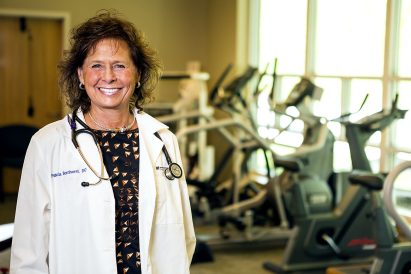
At age 35, Dr. Patricia Bornhorst wasn’t yet a doctor. In fact, she was on the fast-track in her career as an engineer in technical sales, training for a triathlon and travelling to compete on a national level in racquetball. And then, she was diagnosed with ovarian cancer. “I was in the prime of life flying full steam ahead, at a time when I had never been more fit or competitive at my sport,” Bornhorst said. She went through multiple surgeries and two rounds of chemotherapy, and hasn’t had a recurrence. Now, she’s part of Washington Health System’s Physical Medicine and Sports Rehabilitation Program at the Wilfred Cameron Wellness Center, and she’s the team physician for the Washington Wild Things and the Pennsylvania Rebellion, focusing on sports rehab and concussion management, as well as cancer rehab.
How did your diagnosis and experience of cancer spur your career change?
“One of my best friends had just finished residency and started a new practice. I dreamed of what it would be like to be in her shoes, but then came to the resolution that the opportunity had already passed. I instead took a position in healthcare technical sales. I was diagnosed within that year.
Through this humbling experience, I realized that God had given me a gift that I could give back to others. I understood inherently what it was like to have a head-on collision with the knowledge that from that moment forward, life would never be the same. I always felt that things in life happen for a reason and we are all here for a reason. It never becomes more apparent than a news story of a harrowing rescue, of a life saved, or a story told of one’s life experience that inspires the masses. I believe that we are all more connected then we realize. I also believe in miraculous serendipity – when all of the sudden the right person appears, or the opportunity opens, or the words from a stranger make a resounding echo long after the chance passing.
My serendipitous event came when I happened to glance at a front page article in the Sunday paper. It was about a woman who was graduating from medical school at the age of 52 after having already raised a family. I was recovering from the aftermath of chemo at the time and thought, ‘Wow, what if…?’ I stuffed the article in my pocket. As the years went by, I tried throwing it away a couple of times – always rescuing it out of the trash, because whether I was able to attain my dream or not, I couldn’t bear to throw it away. I held onto it and the dream of becoming a doctor sometimes tighter than life itself. In some ways, I think it gave me a reason to fight, reason to be here. As I my life continued to unfold, I realized I had been given a tremendous gift. It was an understanding, a presence, an insight, that I could give back to a patient that few would have the opportunity to do. So the cancer was a gift and it’s what led me to follow that first whisper in my heart over 20 years ago.”
What does cancer rehabilitation entail – how long does it last, when does it begin?
“Cancer varies widely in prognosis, management, treatment, and in the associated sequelae of adverse physical impairments. These impairments depend on the location and stage of cancer and result from a variety of treatment protocols involving surgery, radiation, chemotherapy, hormonal or immune therapy. Often times either during or after treatments are completed, the survivor will suffer from a number of functional physical impairments which can make performing basic daily living activities a real chore or next to impossible.
Cancer rehabilitation specializes in the identification, evaluation and rehabilitation of functional impairments due to musculoskeletal and neuromuscular disorders associated with cancer and its treatment. The goal is the restoration and maintenance of function of activities of daily living for an improved quality of life. This can mean while undergoing treatment, or post-treatment and sometimes years after diagnosis.
Diminishing the detrimental effects of functional impairments related to cancer requires an understanding of the interrelationship between treatments involving surgery, radiation and chemotherapy with pre-existing disorders of the cancer survivor as well as an understanding of the disease itself. This requires a coordination of efforts of a treatment team that includes a physiatrist, one who specializes in physical medicine and rehabilitation. Ideally, it begins at the point of diagnosis, follows the survivor through treatments, assessing and assisting with any resulting physical limitations that may impair daily function. It can provide surveillance and a focal point for support for any post treatment complications that may arise in the future.”
What kind of rehabilitation would a breast cancer survivor need?
“The risk of developing breast cancer is 1 in 8 and there can be several long-term adverse effects of surgery and radiation. One that’s highly specific to breast cancer treatment is lymphedema, a frequent complication and approaches up to 30 percent of post-treatment survivors. The risk increases with axillary dissections and removal of regional lymph nodes. It presents with upper extremity swelling, after mastectomy or lumpectomy. In a 2010 Livestrong survey of 3,129 survivors who had finished treatment in the past five years, 86 percent reported at least one impairment. These impairments may stem from treatments or the disease itself. Some comorbidities that can be associated with breast cancer and its treatment are rib fractures, radiation fibrosis and pneumonitis, neuropathy, brachio plexopathy, lymphedema, fatigue and slowed cognition, to name a few.
These can lead to complications such as cervical dystonia, neck extensor weakness or dropped head syndrome and trismus, or the inability to fully open the mouth, as well as neuropathy and shoulder conditions such as adhesive capsulitis, known as ‘frozen shoulder.’ Neuromuscular re-education focusing on postural correction and proprioceptive re-education, as well as soft tissue mobilization techniques, nerve stabilizing agents and certain braces/orthotics are used to treat these conditions.
Breast cancer survivors can also suffer from post mastectomy pain syndrome, loss of shoulder range of motion, secondary sleep disruption and a diminished capacity to perform occupational duties or vocational pursuits. A 2010 study found that weight lifting in these patients actually reduced the risk of lymphedema rather than worsening it as previously thought. This impairment, along with shoulder contractures, can be treated through targeted physical therapy to improve range of motion, injections to assist with pain, progressive-resistance strengthening and compression garments.
Many more conditions of the upper and lower extremities such as osteoarthritis, inflammatory arthritis such as gout, spinal stenosis, bursitis, myofascial back and buttock pain, radiculopathy and radiating leg pain, generalized weakness and walking difficulties as well as balance issues are treatable conditions in the field of physical medicine and rehabilitation. At Washington Hospital, we have a dedicated and experienced team of therapists specializing in lymphedema management as well as treating the many musculoskeletal and neuromuscular conditions above. We also offer a variety of procedures involving trigger point injections, ultrasound-guided peripheral injections for osteoarthritis, tendinitis and neuropathy such as in carpal tunnel syndrome, as well as glenohumeral and subacromial injections for certain shoulder conditions for example. We believe in a multidisciplinary approach that involves a variety of aspects in healing, such as nutrition, education, complementary therapies such as acupuncture, reiki or massage, to name a few.”
You are also the team physician for the Washington Wild Things and the Pennsylvania Rebellion, and you work with concussion management. Is it difficult to shift gears from cancer rehab, or do the specialties have similarities?
“There are similarities and differences between both depending on the causes of the conditions. The similarities are that both can take you out of action but by different mechanisms. In a concussion, a common symptom or complaint is a feeling of being in a ‘fog,’ difficulty with memory or concentration, usually trauma induced and typically transient. One of the side effects of chemotherapy can be similar to the complaints of feeling like in a fog or slowed cognition and often is called ‘chemo brain,’ which is not trauma-induced, however can be a long term sequela of treatment for cancer. I consider both types of patients – speaking from experience – whether an athlete or survivor, is a warrior in their own right whether fighting for a title or fighting for their life. So in many ways, the two are similar.
It’s not difficult to switch gears because inherent in our training as physiatrists and sports medicine physicians, we deal with many types of conditions and patients. Whether they are younger or older, athletes or non-athletes, they all have a common goal and that is to get back to their function and quality of life before the incident that derailed them happened.
So, in some ways, it feels like I’ve been training for this position most of my life.”
Dr. Patricia Bornhost can be reached at 724-229-2700.