

Notice: Undefined variable: paywall_console_msg in /usr/web/cs-washington.ogdennews.com/wp-content/themes/News_Core_2023_WashCluster/includes/single/single_post_meta_query.php on line 71
Notice: Undefined offset: 0 in /usr/web/cs-washington.ogdennews.com/wp-content/themes/News_Core_2023_WashCluster/single.php on line 18
Notice: Trying to get property 'cat_ID' of non-object in /usr/web/cs-washington.ogdennews.com/wp-content/themes/News_Core_2023_WashCluster/single.php on line 18
Dr. Jennifer Salvitti Davis sheds light on cataract surgery and how technology has changed the procedures
Notice: Undefined offset: 0 in /usr/web/cs-washington.ogdennews.com/wp-content/themes/News_Core_2023_WashCluster/includes/single/strategically_placed_photos_article.php on line 412
Notice: Trying to get property 'term_id' of non-object in /usr/web/cs-washington.ogdennews.com/wp-content/themes/News_Core_2023_WashCluster/includes/single/strategically_placed_photos_article.php on line 412
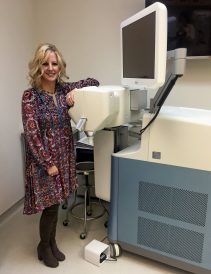
Medical technology has made great strides in recent years, and cataract surgery is no exception. The advent of laser-assisted procedures and implants has allowed patients to take control of their vision earlier, and, in some cases, eliminates the need for glasses all together. We spoke with Dr. Jennifer Salvitti Davis at Southwestern Pennsylvania Eye Center about cataracts – something that, if we live long enough, we will all likely develop. Dr. Davis specializes in the diagnosis and treatment of eye diseases and performs cataract, refractive and laser surgical procedures. She holds a bachelor’s degree in molecular biology from Vanderbilt University and her medical degree from Temple University. She completed her ophthalmology residency at the Eye and Ear Institute – University of Pittsburgh Medical Center.
What exactly is a cataract?
A clouding of the natural lens in the eye.
What are the risk factors for it?
Family history is a big risk factor. Diabetes, history of steroid use (Prednisone), smoking, sun exposure and prior eye surgery are the major risk factors.
How is it treated?
Traditional surgery has been done for many years. Basically, the lens is taken out and an implant is put in its place, usually made of acrylic. If it’s left untreated, the patient goes through gradual vision loss.
So, there’s no alternative to surgery?
There isn’t. There are lifestyle choices that you can make to help slow the growth of the cataract – healthy living, antioxidents (because it’s oxidation of the lens that actually causes the cataracts to form). We tend to see that sometimes our healthier patients will live longer without cataract formation – but that’s not always true because genetics do play into it.
Since there are different types of surgery for cataracts, how do you determine which one is best for each patient?
Usually it entails a lengthy discussion. A lot of it has to do with patient expectations. With the baby boomers coming into the cataract age, expectations are a little different than they used to be. It used to be that we could just treat the cataract and patients could see better, they were happy – they didn’t care if they wore glasses. Now, it’s a little different because the technology is better and people are aware of that. So they want better vision, and better vision without glasses. Insurance pays for traditional surgery, but they don’t pay for deluxe products – the deluxe lenses that allow you to see without glasses – and they don’t pay for laser. So, a lot of it does depend on what the patient expects and what the patient is willing to pay out of pocket to get a certain outcome.
You mentioned the “cataract age.” What age range is that?
It used to be older patients – 80 year olds, 90 year olds, that’s when the surgery was done. But because of the advances in technology and the decreased risk factors involved with the surgery, better surgery is allowing us to be more precise. Patients tend to have the surgery before they are “ripe.” That term was used long ago, it means you basically had to be blind before they would do cataract surgery. Now that’s different, so patients have it at an earlier age when it truly affects their daily vision, not necessarily when they’re blind. So now, we do a lot of patients in their 50s and 60s. It’s not unusual to see a patient in their 30s or 40s have a cataract, but that’s genetic or medication-induced.
What is the out of pocket cost?
It varies among practices and it varies depending on the different products that are used. Some ophthalmologists don’t do anything that would be out of pocket. A lot of this plays into how technologically-advanced the practice is. Traditional surgery is covered by most insurances. Some people have co-pays and deductibles. The cost can be anywhere from $1,000 per eye to $3,000 per eye. We have the technology that’s added, but also implants that can allow you to see both distance and near. Those cost extra because they’re totally unnecessary – it’s just allowing people to be free from reading glasses or glasses in general. Like LASIK surgery, its a choice that you don’t want to wear glasses, so that’s an out of pocket expense.
What does the laser-assisted cataract surgery entail and what is the recovery?
The recovery for laser cataract surgery is very similar to traditional cataract surgery. It’s not a lot different, it’s just that we are using the technology of a laser to do part of what would normally be done by hand. A lot of people think that cataract surgery was always done by laser, and that’s incorrect. Only part of the surgery is done with laser assistance. The laser makes the incisions, corrects astigmatism, it cuts open the front of the cataract and it chops the cataract so we use less energy to take it out. The surgery is basically becoming more accurate and precise and more predictable in general – incisions are being made by a computer and not by hand. Cataract surgery in general, you start to see some vision recovery in a couple of days. A lot of patients can see 20/20 the day after surgery, which is great. Some people go through a longer recovery, just because of the density of the cataract. But the laser doesn’t necessarily make the visual recovery faster. Usually the eyes are very well healed within 4-6 weeks.
How long has your practice been doing the laser-assisted surgeries?
We’ve been doing it since September 2012.
Is the patient awake for cataract surgery?
It is done with IV sedation, so patients get twilight sedation and it really just takes the edge off. Patients aren’t put to sleep – though some fall asleep – it’s enough sedation to keep them calm, but often they talk to us during the procedure. For patients with certain medical conditions, it’s safer to not give them sedation, and really they do quite well with it. It’s really the idea of surgery and that’s why sedation helps. And also, the microscope is quite bright. For some, it’s difficult to sit still and look at the bright light, so that’s really why sedation is given. We have topical anesthesia, and medications that we place in the eye during surgery that make them feel more comfortable and allows them to be awake. Sometimes, patients think they should be completely out, so we have do discuss that they’ll hear us, and in most situations, patients say it’s a lot better than they expect it to be.
Are there any other new advancements or technology that your practice is using?
We have new technology in the operating room that is starting to be used nationwide, called ORA, which is Optiwave Refractive Analysis. That’s a device in the operating room that helps use wavefront guidance to help us measure the cataract after the eye is out – it adds to the precision of the surgery by helping us select an implant. Not only do we use the measurements before surgery – when patients are having laser or advanced technology procedures, we tend to do multiple measurements before surgery – and then we have another measurement that we can do at the time of surgery, all just adding to the precision of the procedure. So, that’s actually been a huge benefit because we’ve had a lot of patients who have had LASIK or other procedures in the past and that changes the curvature of the cornea and affects the measurements we get in the office – that makes it harder to be very accurate with which implant we select. This helps us a lot because it’s very customized to the patient. So we’re able to more properly and more accurately select the implant, especially in those patients.