

Notice: Undefined variable: paywall_console_msg in /usr/web/cs-washington.ogdennews.com/wp-content/themes/News_Core_2023_WashCluster/includes/single/single_post_meta_query.php on line 71
Notice: Undefined offset: 0 in /usr/web/cs-washington.ogdennews.com/wp-content/themes/News_Core_2023_WashCluster/single.php on line 18
Notice: Trying to get property 'cat_ID' of non-object in /usr/web/cs-washington.ogdennews.com/wp-content/themes/News_Core_2023_WashCluster/single.php on line 18
High blood pressure: the new numbers
Notice: Undefined offset: 0 in /usr/web/cs-washington.ogdennews.com/wp-content/themes/News_Core_2023_WashCluster/includes/single/strategically_placed_photos_article.php on line 412
Notice: Trying to get property 'term_id' of non-object in /usr/web/cs-washington.ogdennews.com/wp-content/themes/News_Core_2023_WashCluster/includes/single/strategically_placed_photos_article.php on line 412
Celesta Van Kirk
Celesta Van Kirk
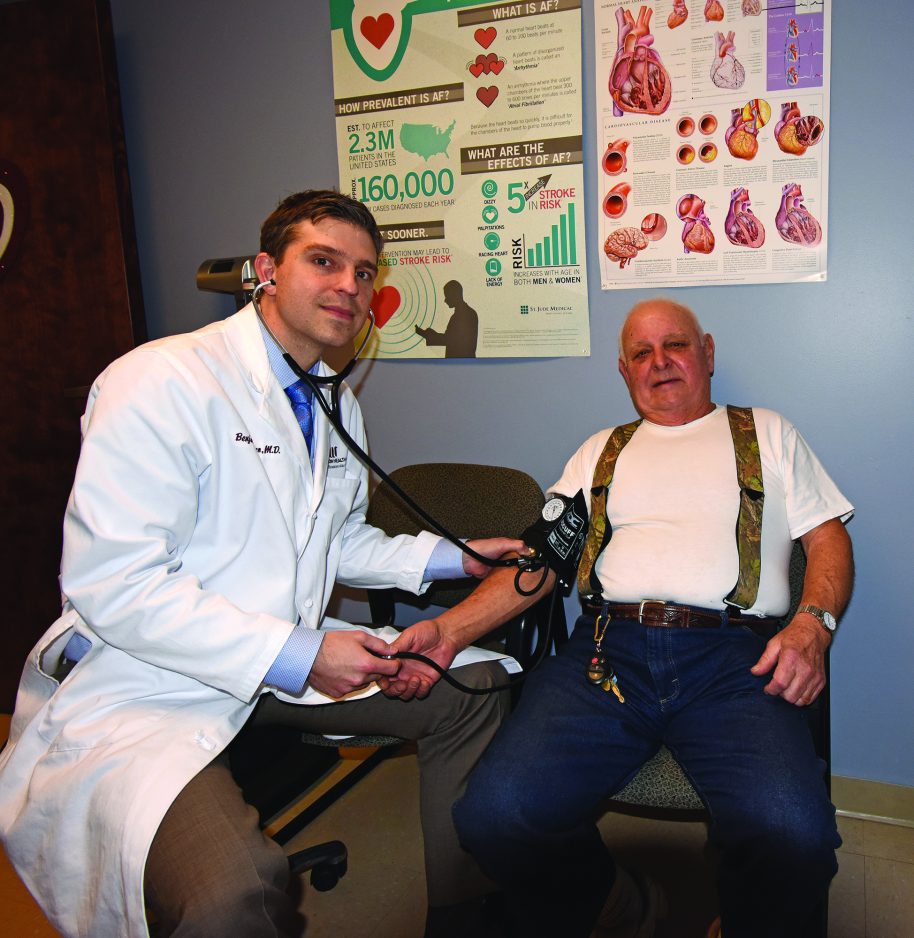
Dr. Benjamin Susco checking the blood pressure of his patient Barnie Slay at the Washington Outpatient Cardiac Diagnostic Center in Washington.
Did you know that nearly one third of American adults have high blood pressure? That was the statistic reported in 2016, and it’s about to rise dramatically thanks to a change in guidelines on blood pressure target numbers. Even more worrisome is the fact that only half of those who have high blood pressure are controlling the condition. The American College of Cardiology and the American Heart Association recently revised blood pressure targets and treatment recommendations. Patients are now considered to have Stage I hypertension (high blood pressure) with a systolic reading of 130-139mmHg or diastolic blood reading of 80-89mmHg. Both of those numbers are lower than previous guidelines.
The guidelines change means more people will be classified as having hypertension. But why? Recent key trials provided evidence that lower blood pressure reduces cardiovascular risk. It’s meant to be preventative and to encourage people to take a more active role in lowering their blood pressure earlier before it causes medical problems.
“I think that the change in the threshold numbers for classifying high blood pressure is a great step to help lowering a lot of patients’ cardiovascular risk,” says Dr. Benjamin Susco, a cardiologist with Washington Health System Cardiovascular Care. “This change in classification is beneficial, because this starts by having the patient take an active role in changing their lifestyle before medical therapy is needed.”
In other words, don’t think of it as being diagnosed with a sudden illness, but rather as a heads up or warning that you need to make lifestyle changes that can lower your blood pressure before it causes you serious problems.
What is blood pressure?
It’s defined as the pressure of the blood in the circulatory system – basically how hard your blood is pumping through your veins. High blood pressure (hypertension) is when your blood pumps through your arteries at a higher pressure than it should. That’s dangerous because, it increases the risk of serious health issues such as heart attack and stroke. In fact, high blood pressure contributes to 70 percent of first heart attacks and 80 percent of first strokes. In patients who are diagnosed with chronic heart failure, 70 percent have high blood pressure. Kidney disease is also a major risk factor for high blood pressure.
Why does it happen?
There are all sorts of risk factors for hypertension, including diet, ethnicity, age and other variables. “Some risk factors for developing hypertension include obesity, aging, diabetes, tobacco abuse, heavy caffeine usage, a sedentary lifestyle, emotional stress and a poor diet with high levels of sodium intake,” Susco says.
Some of these issues are out of our control, but others are not. There are steps we can take to help lower our blood pressure and some are as simple as moving more and eating and drinking better things. Lifestyle changes like increasing physical activity and stopping smoking are crucial. “Most doctors will recommend a low sodium diet such as the DASH diet, which is rich in fruits, vegetables and grains,” Susco says. “Increasing physical activity and decreasing alcohol consumption are healthy recommendations as well.”
When to see a doctor
You should consider seeing a physician if you have elevated blood pressure. Susco explains, “By the new ACC/AHA 2017 guidelines, elevated systolic blood pressure is considered 120-129mmHg. Hypertension is now diagnosed when systolic blood pressure is greater than 130mmHg. These organizations recommend lifestyle changes and reassessment of blood pressure in three to six months after the initial diagnosis.”
If lifestyle and diet changes don’t help to lower your numbers, medication may help. Many health professionals are hopeful that by changing the guidelines for hypertension diagnosis, earlier intervention may reduce the need for eventual medication. “The goal of blood pressure guidelines is not necessarily to place more people on medicines, but to ensure patients have their blood pressure under control,” Susco says. “This starts with lifestyle changes, including weight loss, sodium reduction, increasing physical activity and eating a healthy diet. If blood pressure cannot be controlled with these measures, patients may require medicines all in an effort to lower the blood pressure and reduced her cardiovascular risk.”
He’s confident that many patients will be successful in lowering their blood pressure simply by changing their diet and exercise routines. “This also provides the patients with a long-term goal and strategy to improve their overall health,” he says. “However, the flip side is that some patients may not respond to just these measures and will require pharmacotherapy (antihypertensive blood pressure medications).”
The bottom line is to get a blood pressure reading, know your numbers and stay on top of any big changes. As for what numbers to shoot for, Susco says the new target ranges apply to everyone no matter what their age.
“Aim for normal blood pressure, which is a systolic blood pressure less than 120mmHg and a diastolic blood pressure less than 80 mmHg,” he advises. “This is the goal for all individuals at this time. Consult your physician for an individual blood pressure assessment and recommendations.”
If you’re concerned about your blood pressure or for more personalized advice, see your primary care doctor. For more details on the new guidelines, visit www.cdc.gov/bloodpressure/facts.htm. v