

Notice: Undefined variable: paywall_console_msg in /usr/web/cs-washington.ogdennews.com/wp-content/themes/News_Core_2023_WashCluster/includes/single/single_post_meta_query.php on line 71
Notice: Undefined offset: 0 in /usr/web/cs-washington.ogdennews.com/wp-content/themes/News_Core_2023_WashCluster/single.php on line 18
Notice: Trying to get property 'cat_ID' of non-object in /usr/web/cs-washington.ogdennews.com/wp-content/themes/News_Core_2023_WashCluster/single.php on line 18
Washington Health System’s CHF Pathway Program employs heart failure navigators to help get patients back on their feet
Notice: Undefined offset: 0 in /usr/web/cs-washington.ogdennews.com/wp-content/themes/News_Core_2023_WashCluster/includes/single/strategically_placed_photos_article.php on line 412
Notice: Trying to get property 'term_id' of non-object in /usr/web/cs-washington.ogdennews.com/wp-content/themes/News_Core_2023_WashCluster/includes/single/strategically_placed_photos_article.php on line 412
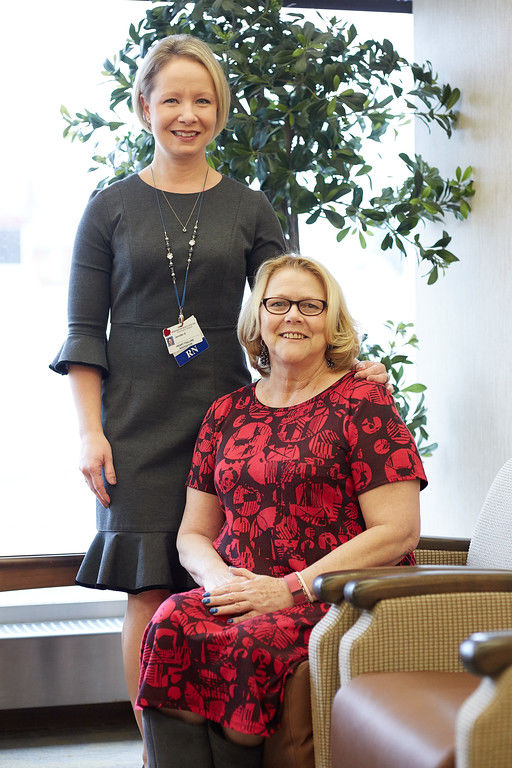
Courtesy Washington Health System
Nurse navigator Jeni Sworden and patient Paula Lis.
Paula Lis is the perfect example of the reason why people should consult their physician before beginning an exercise program.
In July 2017, the 61-year-old Washington resident was working out for the first time with a friend in an effort to lose weight for her son’s June wedding. She didn’t check with her physician prior to beginning her regimen, but when she noticed that her feet and ankles began to swell, she sought him out immediately.
“I tried to keep up with my friend, who is about 20 years younger than me,” she says. “But after my feet and ankles swelled, I knew there was a problem.”
Her physician scheduled her for a CT scan, and two days later, Lis’ son found her laying face down in a pool of blood at their home. When he got her to Washington Health System, doctors diagnosed her with aspirated pneumonia.
They told Lis that the dye required for the CT scan reacted with her kidneys, which then caused her previously undetected stomach ulcers to bleed. They also discovered that her kidneys were failing and she was having problems breathing, but they were not able to determine why.
Two days later, she went into cardiac arrest, which, ironic as it seems, saved her life.
“The doctor told me that my brain saved me by putting me into cardiac arrest,” she says. “Before that happened, they were unable to determine why I couldn’t breathe. But when I went into cardiac arrest, they knew just what to do and how to treat me effectively.”
Pieces of the puzzle began coming together, and her doctors and nurses were able to pinpoint her bad reaction to the CT scan dye as the source of the issues. “My doctors and nurses went out of their way for me. I can’t thank them enough for all of the care I received.”
At this point, Lis met Jennifer (Jeni) Sworden, BSN, a heart failure navigator, who worked with Lis in getting her back to good health. Sworden’s job is to act as a liaison between Lis and her doctors, answer Lis’ questions and make sure she understands her treatment regimen.
“Anything I need or have questions about, I call Jeni,” Lis explains. “She has been with me since all of this happened in July, and she promised to be with me until I no longer need her. And I don’t know what I’d do without her.”
Sworden was only the second heart failure navigator hired at Washington Health System in June 2017. The first was Shelly Sargent, MSN. The nurse navigators are part of a relatively new program at WHS called the CHF Pathway Program.
“The outpatient heart failure program at WHS is a program designed to help patients and families understand and manage the disease process at home and provides contact with the heart failure navigator as a resource to aide them,” Sargent explains.
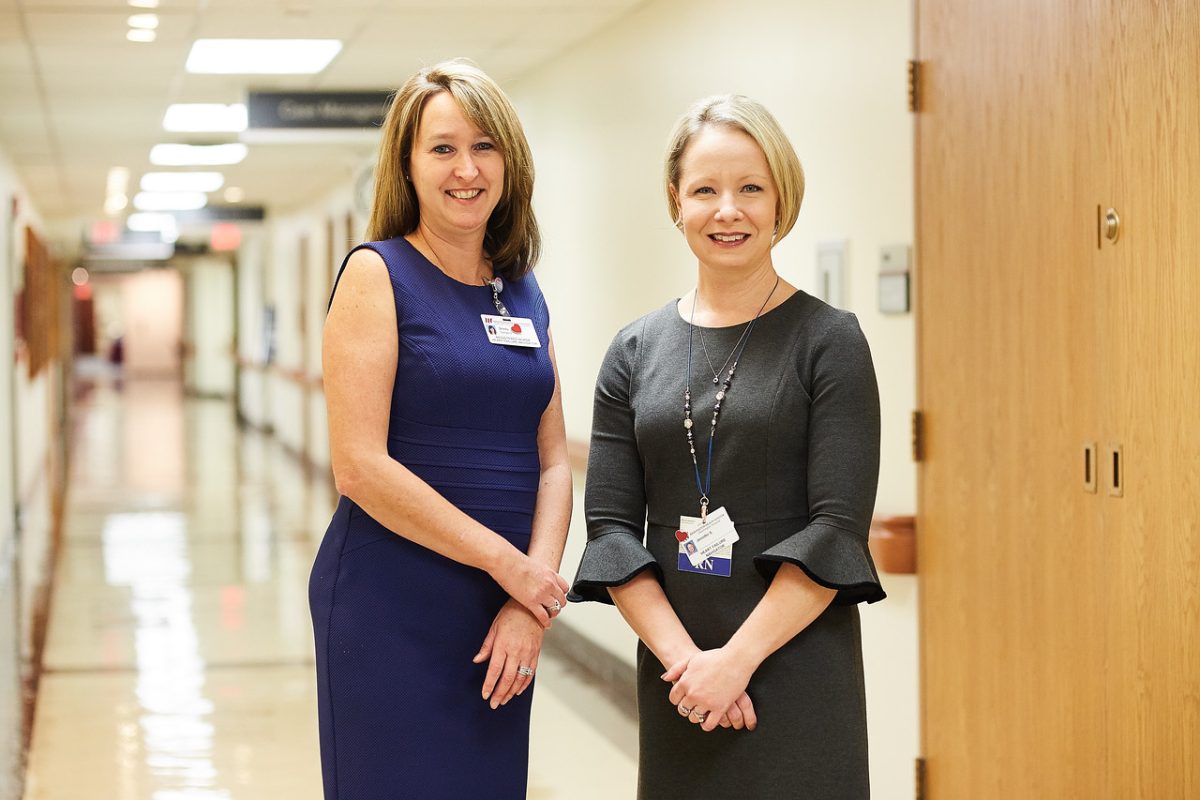
Courtesy Washington Health System
Shelly Sargent and Jeni Sworden, members of the heart failure navigator
team at Washington Health System’s CHF Pathway’s program.
The program began when WHS engaged a multidisciplinary team of primary care physicians, cardiologists, office managers, nurses, electronic health records staff and data analysts to design an ideal state for an ambulatory CHF Pathway patient. Shortly after the group formed, the need for a CHF nurse navigator was identified as a key component to optimize the care and well-being of the patients in the Ambulatory Heart Failure Pathway.
“By using a team approach, best practice elements and patient-centered strategy for an Ambulatory Heart Failure Pathway component that guides patients along the healthcare continuum from inpatient to outpatient, we proudly launched the pathway program in August 2016,” Sargent says.
Due to the success of this pilot, WHS expanded the program by adding a second heart failure navigator, Sworden, who helped to expand the ambulatory program out to all private practices in the WHS service area by November 2017. “By expanding the program, we have engaged and improved the quality of care for even more patients in our community,” Sargent says.
The patient is enrolled in the program after being admitted to the hospital and treated for heart failure. The navigators will meet each patient while they are in the hospital and review the signs and symptoms that the patients should acknowledge, such as shortness of breath, edema, weight gain of three pounds or more in one day or five pounds in a week, Sargent says. “The patients are provided with a self-care bundle that includes a scale, pill case and blood pressure cuff, as well as the phone number of the heart failure navigator. Navigators are on duty Monday to Friday from 7 a.m. to 5 p.m.”
According to Sargent, the role of the heart failure navigator is to serve as a resource, to help patients and families and provide education. They also are called when symptoms develop, and the navigator can adjust diuretic doses based on protocol orders from the cardiologists. Once a dose adjustment has been completed, the heart failure navigator will follow up the next day with the patient. If the symptoms have improved, the navigator reminds the patient to call the next time they develop symptoms. If the symptoms persist, the navigator is able to provide additional dose adjustments, while maintaining access to the cardiologist to discuss the patient’s symptoms and develop a plan.
“In a nutshell, the navigator works with an array of physicians, including cardiologists, primary care physicians and even nephrologists (kidney specialists) to provide the patient with the most comprehensive care to manage their heart failure,” Sargent says.
For Lis, this has meant less stress and more time to recover.
“Jeni even delivered my blood pressure monitor and scale so that I wouldn’t have to make a special trip to pick it up,” she says. “And when I was ordered to have a follow-up MRI, I called Jeni to express my concern over having another test requiring dye. She called all of my doctors and was able to make the necessary arrangements that helped ease my worries.”
Since the program’s inception, more than 600 patients have been enrolled.
As for Lis, she said she’s going to talk to her doctor before returning to exercise.