

Notice: Undefined offset: 0 in /usr/web/cs-washington.ogdennews.com/wp-content/themes/News_Core_2023_WashCluster/includes/single/single_post_meta_query.php on line 43
Notice: Trying to get property 'paywall' of non-object in /usr/web/cs-washington.ogdennews.com/wp-content/themes/News_Core_2023_WashCluster/includes/single/single_post_meta_query.php on line 43
A Death at Twilight: Chapter two
The story so far: Around sunset on Oct. 25, 1828, Rebecca McCrory left home on foot for her sister’s house. She never made it. Her body was found two days later, her throat cut from ear to ear. At first, neighbors thought the pregnant teenager had killed herself, but an inquest and examination proved she had been murdered.
In the 1770s, settlers began claiming lands in Western Pennsylvania. Some of them were Scots-Irish, whose people had migrated from Scotland to Northern Ireland and eventually to America. Some of the pioneers were Quakers who came here from Eastern Pennsylvania and Maryland. Henry Speers arrived from Germany with his wife and four sons, along with other families like the Fryes, the Beazells and the Haxenbakers, settling on the eastern side of the Monongahela River and just across the river in what is now Washington County. Life on the frontier, on land fiercely fought for by American Indians, was tough, but the white settlers prevailed.
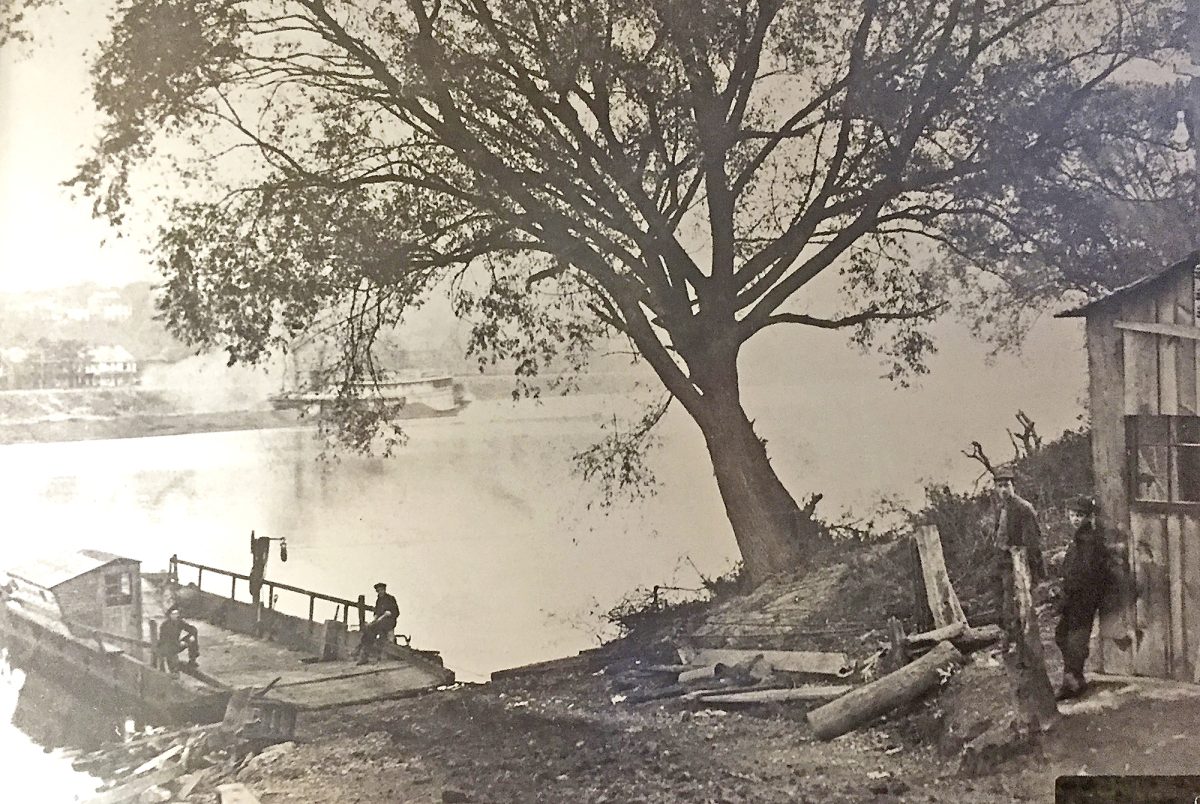
This photo, which hangs in the Back Porch Restaurant, shows a ferry moored on the Speers side of the Monongahela River in the mid 19th century.
Speers’ eldest son, also named Henry, who had been born in Germany in 1756, went on to be ordained a Baptist minister in 1793. He built a large brick house on the western side of the Monongahela River that still stands and is now the Back Porch Restaurant. He would preach at Enon Church until his untimely death, caused by a falling tree, in 1840. One of the more memorable and tragic moments of his life was the murder in 1828 of his granddaughter, Rebecca McCrory.
One of the Rev. Speers’ daughters, Catherine, married John McCrory, and the couple settled on a farm in what later was called Twilight, just a little more than a mile from the river. John operated a sawmill on the property, and the couple would raise nine children, including Rebecca, born in 1811 and named after her grandmother Rebecca Speers. The south branch of Maple Creek ran just a short distance from their house.
Just on the other side of that creek is where Rebecca’s body was found two days after she was last seen alive. Men from neighboring farms formed a coroner’s jury and investigated the crime scene. One of them was John Jackman, 47, a community leader and teacher at the school begun in 1800 at Fallowfield Quaker Church. The men concluded there was no question that the girl had been murdered, but where the crime took place was disputed. Jackman believed she was killed at the spot where her body was found. But most felt that couldn’t have been the case.
“The murder could not have been committed there,” Dr. Robert Playford later testified. “The struggle in dying would have spread the blood about.” And very little blood was found on the log behind which she was found and on the fallen leaves.
Playford recalled that the clay soil that was beneath the body was dug up by the investigators, and there was “no appearance of blood being absorbed by the clay,” despite the fact that, “the great part of the blood in the body would have been discharged from such wounds.”
Perhaps it was Jackman’s Quaker sensibility that refused to allow him to believe that such evil conniving – to transport the corpse from the murder scene to within a few paces from her parents’ home and arrange it to imply suicide – could be possible in such a tight-knit and God-fearing community. But that is apparently what her killer, or killers, had done.
What the men of the jury and everyone else in that community were wondering at that time was why Rebecca was slain and who did it. The fact that the 17-year-old girl was pregnant significantly narrowed – in some minds – the list of suspects.
Joseph Scott, who lived with his grandfather quite a few miles away from the McCrorys, was one of Rebecca’s suitors.
“He wished to court my sister but she refused him,” Pleasant McCrory later testified. He stayed at our house more than one night, and was there several times. One night she got up and left him sitting by the fire. She left him sitting there with the family, and one time with me.”
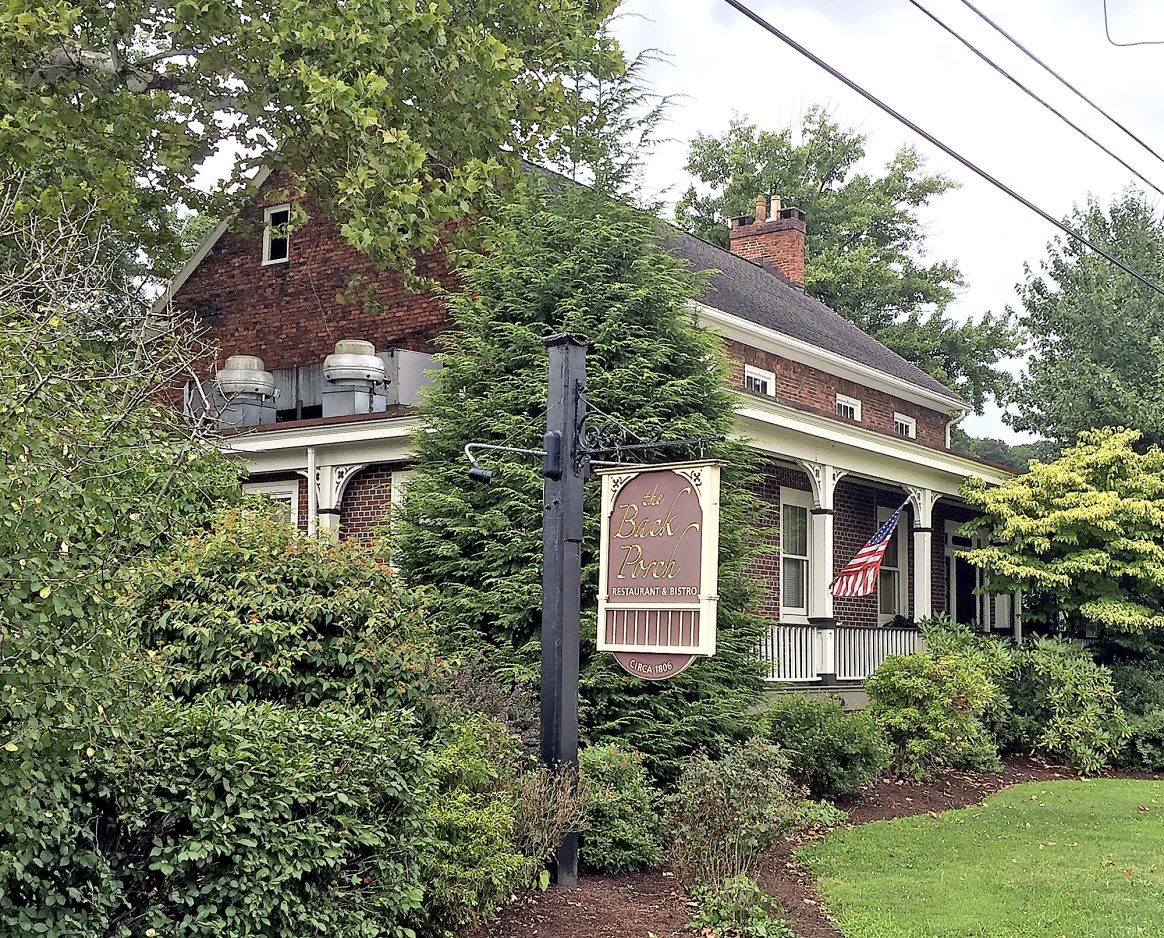
Photo by A. Parker Burroughs
A. Parker Burroughs
The Back Porch Restaurant in Speers has an intriguing history. Henry Speers constructed the brick house beside the Monongahela River in 1806. His granddaughter, Rebecca McCrory, was en route to his house and to that of her sister across the river on Oct. 25, 1828, the night she was murdered.
One suitor Rebecca did not refuse was Edward Nixon, 21, whose family’s farm was less than half a mile away.
“He (Nixon) commenced coming here last September a year ago, sometime early in the fall,” Rebecca’s father later testified. “He frequently visited here once in two or three weeks. They were keeping company like other young folks till just before harvest. Then he quit until Monday a week preceding the death. He came in and asked for school money and I gave it to him. He stayed until bedtime and I left him and my daughter sitting by the fire.”
A wake was held in the McCrory home on the night her body was found at a time when most were still thinking she had taken her own life. Nixon came that night but did not go into the house to view the body or offer condolences – behavior that would soon be seen as more than odd.
After Dr. Playford’s examination on Tuesday morning confirmed Rebecca was murdered, the inquest was resumed and Nixon was sought for questioning. He could not be found, which only added to suspicion of his guilt.
He was not at home, but his horse was and was newly shod. Some suspected he had intended to flee to Ohio.
Before daybreak on Wednesday, William Huggins was wakened by his wife, who had heard a noise downstairs and asked him to investigate. Huggins saw a figure sitting at the fire over the coals.
“Eddie, is that you?” Huggins asked.
Huggins was Nixon’s uncle. The two did not speak for a time.
“What are you going to do?” Huggins asked.
“I don’t know,” Nixon answered.
Huggins told Nixon that people were after him and he did not want him taken at his house.
“He went down on his knees and prayed he might never be happy, or something, if he was not innocent,” Huggins later testified.
Huggins persuaded his nephew to leave, but Nixon slipped into Huggins’ barn unnoticed and remained there until Thursday morning, when he was discovered by his cousin, William Huggins Jr. The younger Huggins warned him that men were after him with a search warrant and asked him if he was hungry.
“I care nothing for eating,” Nixon replied.
The boy helped conceal his cousin under straw, but the elder Huggins later found him there.
“I advised him to give himself up,” Huggins Sr. testified. “He said he would not mind giving up but was afraid of hand swearing. I told him I met men with a search warrant and he went off through the orchard. I saw him again that same evening and told him there were many men after him. … I asked him again what he would do and advised him again to surrender. He agreed to give himself up. I went for Robert Gregg (one of the investigators), and he came down and took him.”
Nixon, weak from hunger, was taken to Magistrate William Hopkins’ house for a hearing. That the murder suspect had been captured and was about to face justice for his crime must have come as relief to the citizens of what was then part of Fallowfield Township.
That relief soon turned to confusion and anger, however, when the rule of law intervened on the part of Edward Nixon.
William Springer, another of the investigators, asked Gregg how things went at the hearing.
“Rough and rugged,” Gregg replied. “He was acquitted because they could not prove a damned thing against him. They had tried their damnedest.”
The rights of the accused were as important in 1828 as they are today. If Nixon were to be jailed, tried and possibly hanged, evidence would have to be found to tie him to the murder.
As the hunt for that evidence began, suspicion of his guilt grew stronger, and Edward Nixon, though free, was a prisoner of fear.
Next: Mrs. Morton witnesses murder in dream